

An unanswered message usually isn't a reason to worry.
People get busy, put their phone on silent, sit in meetings, sleep, or simply need to disconnect.
But when the silence is unusual and you know the person's habits, it can be hard to know whether you should just wait or try to check that everything is okay.
Here are a few simple steps.
Start by Staying Calm
Before imagining the worst, remember that there are plenty of ordinary explanations.
Their phone may be switched off, out of battery, or left somewhere. They may also be busy or simply haven't seen their notifications.
A one-off silence doesn't necessarily mean something is wrong.
Consider Whether the Silence Is Truly Unusual
The first question to ask yourself is simple:
Is this different from their usual habits?
Someone who usually replies after a few hours isn't in the same situation as someone who normally checks in every day at a specific time.
It's the change from their usual routine that is worth paying attention to.
Try Another Way to Reach Them
If a message goes unanswered, a phone call can be a good first step.
When appropriate, you can also try another communication channel or contact someone who lives nearby.
The goal is simply to make sure your loved one is okay, without overwhelming them with messages.
Take the Context into Account
Context can help you understand the situation.
Were they supposed to come home at an unusual time? Did they have a specific activity planned? Had they mentioned a problem or a situation that needed particular attention?
The more unusual the silence is given what you know, the more it may make sense to try to reach them.
When Should You Ask for Help?
If you have concrete reasons to believe someone may be in danger, don't just wait for a message.
Depending on the situation and the country you're in, contact the appropriate emergency services or ask someone nearby to check on your loved one.
In the United States, call 911 to reach emergency services. In Europe, the equivalent number is 112. Other specialized resources may also be available depending on the nature of the situation.
Prevention Rather Than Worry
For people who live alone, it can be helpful to have a trusted contact they're used to checking in with regularly.
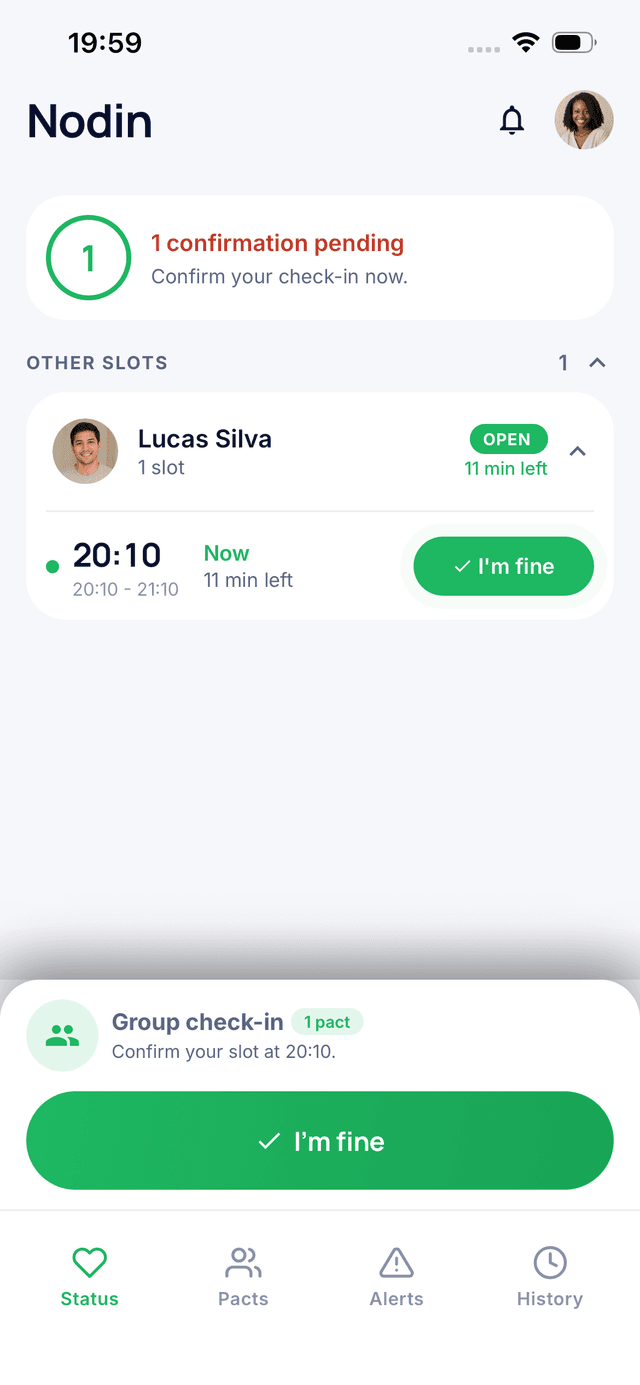
That's one of the ideas behind the Nodin app: creating a simple, mutual daily ritual between two trusted people through a daily sign of life.
The goal isn't to track someone's movements or constantly know what they're doing. It's simply about building a habit that lets you say “I'm okay” and know the other person is there.
Why Habits Matter
Habits make changes easier to notice.
When two people are used to checking in regularly, an unusual absence can naturally catch their attention.
This sometimes makes it possible to simply reach out before worry sets in.
Being Attentive Without Monitoring
Checking in on a loved one shouldn't turn into a form of surveillance.
A healthy relationship gives everyone their own space, pace and independence.
The goal is to find a balance: being present enough to react when something seems unusual, while respecting the other person's autonomy.
Nodin is built around this approach: a sign of life shared voluntarily, mutual care, and a bond that stays present every day.
A Simple Sign of Life Can Be Enough
We can't foresee every situation. But we can build habits that make changes easier to notice.
Sometimes, staying close simply starts with a question:
“Are you doing okay today?”
Stay connected with the people who matter
Nodin is a free app that lets two trusted people share a simple sign of life every day. One tap to say you are okay, and if someone goes silent, the other is notified.